For the business owner who knows the exit is coming but doesn't know where to start.
You're Going to Exit Your Business One Day.
You Just Don't Know How It Actually Works Yet.
You want to sell your business. You've thought about it more than you've told anyone.
You've heard things. From brokers who called out of nowhere claiming to have buyers. From guys at the country club who sold and made it sound simple. From online forums full of opinions from people who may or may not have actually done it.
You know the exit is coming eventually.
What you don't know is where to start, what questions to ask, or who in this process you can actually trust.
I wrote this book for you.

Here's the number that should stop you cold.

What I've learned from twenty years and more than 300 closed transactions is that most business owners who sell do not get what they should have gotten.
Not because they built a bad business. Because they started preparing after they were already motivated to be done, which is the worst possible time to start.
4 out of 5 businesses listed for sale never sell.
Of the 20% that do sell, only about 20%t of those close on terms the owner is genuinely satisfied with. Run the math. That means roughly 4% of businesses that go to market end up with an exit the owner would call a win.
The other 96% either don't sell at all, or sell and regret it.
The owners who land in that four percent made different decisions earlier. That's it. That's the whole thing.
There is a difference between selling your business and executing a Peak Exit.
Selling happens when you're ready to be done. A Peak Exit is built deliberately, years before you need it. This book is about the second one.
You've spent years building a real business. Here's what's at stake.
It has taken years and it has cost you things other people don't fully understand.
There is no Carmax for companies. No Zillow for your life's work. You cannot look up a comparable sale, set a listing price, and wait for an offer. Every business is different, every buyer is different, and the process is nothing like what most owners expect until they are already inside it.
At some point you will hand this business to someone else. When that happens, you will either have designed that moment or you will have defaulted into it. One of those feels like a finish line. The other feels like running out of road.
Most owners default. Not because they're careless. Because nobody ever gave them a clear picture of how the process works before they were already inside it.
That's exactly what I'm going to fix.
And if you're thinking "I'm not ready to sell yet, so this doesn't apply to me": read the part above again.
The owners who land in the four percent didn't start preparing when they were ready to sell. They started years earlier, when the business still had time to change. If you wait until you're motivated to exit, you negotiate from weakness. The buyer knows it. The broker knows it. And the terms you get will reflect it.
The best time to read this book is before you need it.
I've seen this go wrong up close. Including once that still costs me sleep.

Early in my career I watched a solid business come apart at the closing table. The owner had built real value over more than a decade. The preparation had never happened. When a serious buyer started pulling on the threads, the deal collapsed.
I've seen versions of that story many times since. The details change. The outcome doesn't.
I've watched deals unravel because the financials told a story no buyer would believe. Books prepared for tax efficiency, not for sale, with profit buried so deep under add-backs and personal expenses that the recast looked like fiction even when it was accurate.
I've seen owners get stood up at the closing table when bank financing fell through at the last minute, after months of preparation, because nobody had stress-tested the deal structure.
I've seen buyers retrade at the eleventh hour after discovering problems in due diligence the seller knew about and never disclosed. Problems that were fixable. Problems that became leverage.
I've seen deals die because the business was too dependent on the owner and the buyer finally asked the question nobody had answered: what happens here after you leave?
I've seen owners agree to post-sale earnouts and transition periods that locked them into the business for years, going from running the place to being managed by the people who bought it.
I've seen a firearms retailer on Main Street, worth several million dollars, get picked apart after the owner died without a succession plan. His kids were overseas. The employees had the safe codes. The ex-wife had the house. By the time anyone with authority arrived, most of the inventory had walked out the door. The kids liquidated what was left online. Twenty years of community goodwill, gone.
I've seen a healthcare group with 22 partners take an $18,000,000 haircut because their bookkeeper included PPP grant money as revenue in the EBITDA calculation. The buyer found it. The deal nearly blew up. The partners turned on each other.
I've seen owners sell for far less than they needed, fund the next phase of life with a number that looked fine at closing and ran out two years later.
The one that shaped everything for me happened closer to home. When I was a teenager, my family had a business on track for an eight-figure exit. The deal was real. The number was real. And then it wasn't. The business imploded. Everything that had been built, and everything we thought was secured, was gone.
I spent the next twenty years learning exactly what goes wrong and why. Three hundred transactions later, I still think about that one.
Peak Exit is the book I wish had existed before any of it.
Here's what the book actually gives you.
Not theory. Not motivation. A practical, direct walkthrough of how a business sale actually works: valuation, transferability, deal structure, the things that kill transactions, and the planning process that prevents them.
By the time you finish it, you will know what your business is worth and why. You will know what buyers actually measure and how to move those numbers in your favor. You will know the difference between a good offer and a good deal.
And you will have a clear picture of what needs to happen before you ever call a broker.
How to build a written exit plan so that when the moment comes, you are executing a strategy rather than reacting to circumstances. (Ch. 10)
Why four out of five businesses never sell, and the specific conditions that put yours in the twenty percent. (Ch. 2)
How valuation actually works. Not the free broker estimate, not the expensive firm report, but the method that gives you a number you can use and defend. (Ch. 5)
The Value Mountain: three distinct valuation ranges based on business size and earnings. Where you fall on the mountain is determined by the numbers. Where you land within your range is something you can directly influence, if you know which levers to pull. (Ch. 6-7)
The 16 Value Boosters: the specific, concrete factors that move a business toward the top of its valuation range. Owner dependency. Customer concentration. Documented systems. Market differentiation. These are not abstract concepts. They are measurable conditions that buyers price, and most of them can be improved with time and a plan. (Ch. 7)
The VST Triangle: every serious buyer evaluates three things simultaneously: whether your business is Valuable, Sellable, and Transferable. Most owners have only ever thought hard about one of those. Understanding all three changes how you build and present the business. (Ch. 9)
Why owner dependency is the single most common reason deals collapse in due diligence, and how to fix it before it costs you. (Ch. 8-9)
How to define what you actually want from the exit, including what your life looks like after it, before you sit down with a buyer. (Ch. 4)
How to build a written exit plan so that when the moment comes, you are executing a strategy rather than reacting to circumstances. (Ch. 10)
Three Real Exits. Three Very Different Outcomes.
Let me show you what the difference looks like in practice.
He got the money. He lost everything he actually sold for.
Tom had a ski rental business in one of Colorado's mountain counties. Long-standing relationships with property managers and concierge desks, built over years. He worked half the year and made a great living. He was also burned out. Tired of turning screws on powder days while his friends were out skiing.
We helped him maximize the value of the business, found him a buyer, and he sold for $1,500,000. He was thrilled at closing.
He paid our fee. He paid his taxes. He paid off some debt. He finished his cabin in the mountains, bought a new set of skis, and chased snow.
Three years later he called me asking for a job.
The money had shrunk to a few hundred thousand dollars. Not enough to sustain his lifestyle for more than another year or two. He had spent twenty years building his identity around that business. When the check cleared and the business was gone, there was nothing waiting on the other side. He had a transaction plan. He never had an exit plan.
Tom got the number. He never got the exit.
He got the number. He never got the exit.
Rick was a doctor who came to us with one objective: maximum dollars for his practice. He achieved it. We helped him get full value and he walked away with $5,000,000.
The deal also required that he stick around for a three-year transition period with the acquiring corporation.
In his practice, Rick had been completely free. If he wanted to get away for a few days, he simply didn't take cases that week. He could go skiing when the powder was perfect. He set his own schedule. That was gone the moment he signed.
The corporation that paid him $5,000,000 now dictated when he showed up and what he did when he got there. Three years of it. If he walked early, he forfeited half the payout.
He described it as feeling like prison. Plenty of money. No freedom. No way out.
Nobody had ever asked Rick what he wanted his life to look like after the sale. The question never came up. We got him the price. We missed the point.
Rick got the money. He lost everything he actually sold the practice to get.
He designed the outcome before the deal started.
Ryan built an adventure recreation business and came to us before he went to market. That's the whole difference right there.
Before we talked price or structure or buyers, we talked about what Ryan actually wanted when it was over. What he wanted to do next. What kind of life he was building toward.
That answer shaped everything. We structured the sale of his flagship location to his own general manager. He took enough off the table to fund retirement and redeployed the rest to launch an adventure recreation franchise. He opened new locations. He began consulting around the world on the model he had built.
Ryan got a check at closing and never walked back into that business. Not because he had to stay away. Because he was already fully committed to what came next. He had designed that before the deal started.
Same market as Tom. Same basic transaction as Rick. A completely different outcome because the planning started earlier and was aimed at something beyond the closing date.
Ryan is who this book is trying to make you.
What twenty years of closed deals taught me that no calculator ever will.
The book is built around frameworks I've developed over twenty years that you won't find in an online calculator or a broker's sales pitch.
Most valuation tools will put a number on your business and leave you there. Most advisors will tell you what the market looks like right now. What they won't give you is a way to see your business the way a serious buyer sees it.
What it's actually worth, what's quietly dragging that number down, and whether a buyer can step in and run it without you standing behind them.
These frameworks do that. They came from the closing table, not a classroom. Every one of them was sharpened by deals that worked and deals that didn't.
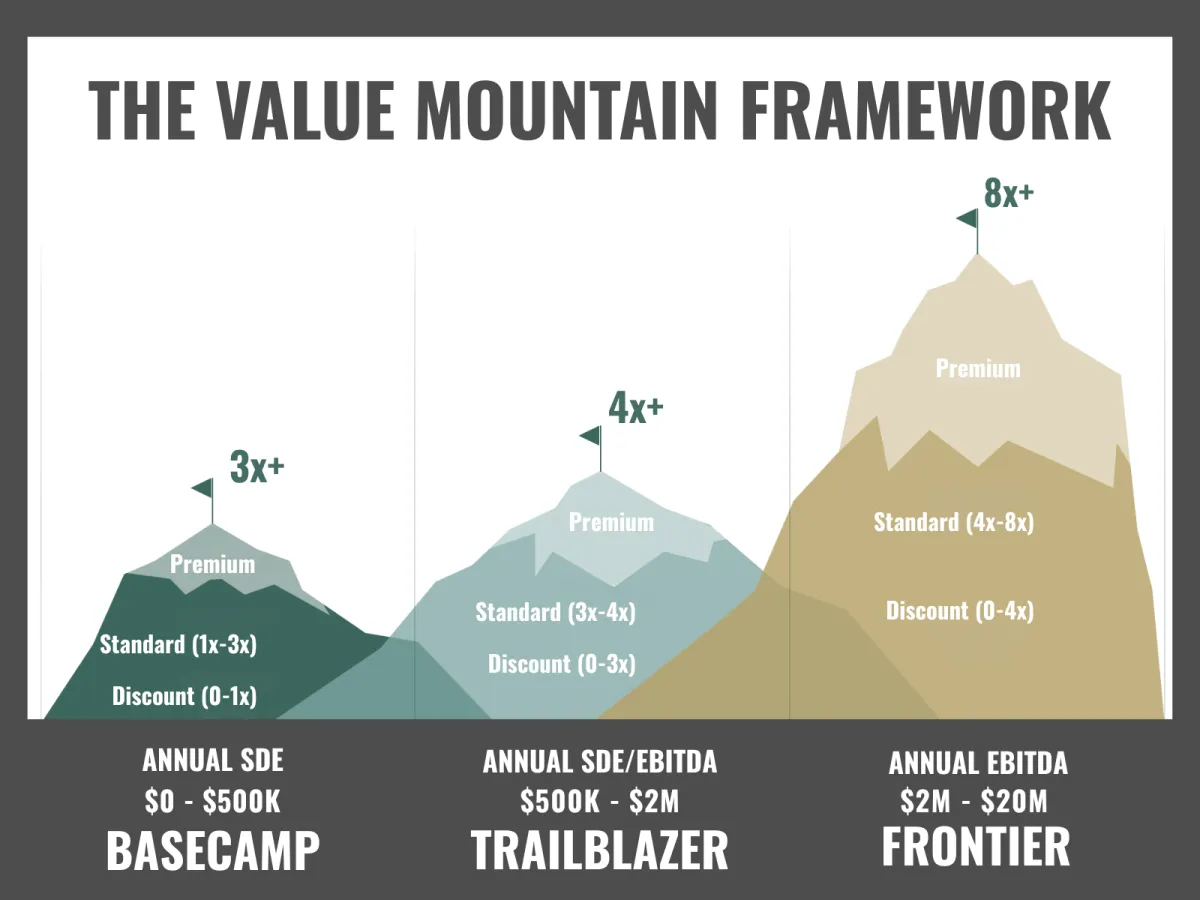
The Value Mountains
Your business sits on one of three mountains, determined by earnings. Not by your industry, not by how hard you worked, and not by what a broker tells you it is worth.
The Basecamp Mountain covers businesses with $0 to $500,000 in earnings. Multiples here run 1x to 3x Seller Discretionary Earnings. The Trailblazer Mountain covers $500,000 to $2,000,000 in earnings, multiples from 3x to 4x. The Frontier Mountain covers $2,000,000 to $20,000,000, where multiples run 4x to 8x EBITDA.
Most brokers stop at the science. They put you on the mountain and call it done. Peak Exit is about what happens next.

The 16 Value Boosters
Every business has conditions that push it toward the top of its valuation range and conditions that drag it toward the bottom. These are the value boosters.
Some are visible: owner dependency, customer concentration, documented systems, brand strength, profit margins, depth of management. Others stay hidden until a buyer finds them in due diligence, which is the worst possible time to discover them.
The boosters are not a universal checklist. What moves the needle in one business may be irrelevant in another. The work is identifying the specific levers in your specific situation, knowing which ones to pull, and doing it while you still have time to change the outcome.
The worst thing you can do is look past the problems that make the picture uncomfortable. Buyers assume the worst about surprises they find on their own. The goal is to find every weakness before the buyer does, and either fix it or present it honestly as an opportunity the next owner can capitalize on.
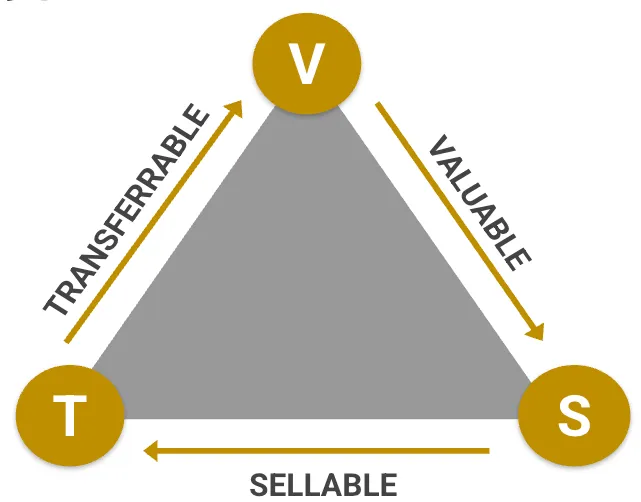
The VST Triangle
Every serious buyer evaluates your business through three lenses at once: Valuable, Sellable, and Transferable.
Valuable means the business generates enough earnings to justify the price. Most owners think about this one. Sellable means a real market of buyers exists for this type of business and the structure allows a transaction to happen. Transferable means a new owner can step in and run it without you standing behind them.
Most owners have only ever thought hard about one of those three. They know the business makes money. They assume it will sell. They have never once asked whether it could run without them for thirty days.
That last question is often where deals die. A buyer who cannot see themselves operating independently will either walk or retrade at the last minute. Either way, it costs you money you should have kept.
Value without transferability is a job, not a business. Sellability without value is a conversation that never becomes a transaction. All three together is a Peak Exit.
Here's how to get your hands on Peak Exit.
Order takes about sixty seconds. You'll get an email confirmation with your PDF and a link to the online resource library. Everything is waiting for you on the other side of one decision.

A PDF Copy of the Peak Exit book.
Peak Exit is a complete field guide to the exit process, written for the business owner who wants to understand how this works before they are inside it. Ten chapters covering valuation, transferability, deal structure, the planning process, and the decisions that determine whether your exit ends up in the four percent or the ninety-six.
Delivered as a PDF the moment your order is confirmed.

The online resource library. Included with your order.
Your purchase includes access to our online resource library. It currently houses three planning tools built to help you apply what you read directly to your own business. We add to it over time, so as new resources are developed you will have access to those too.
The Peak Exit Journal walks you through every framework in the book applied to your specific situation. By the time you finish it, you have a written exit plan, not
just a clearer picture of the problem.
10 Buyer Red Flags and How to Fix Them names the ten conditions that reliably kill deals in due diligence and gives you the concrete fix for each one. Most of these are avoidable. Almost none of them get fixed when owners don't know to look for them.
The Exit Killers Quick Guide is a reference covering the ten most common ways transactions collapse. Keep it on your desk. Review it before any significant move in your exit process.
This is the part where you make a decision.
Peak Exit arms you with the information you need to make the hard ones. What your business is actually worth. What a buyer is going to find when they start pulling threads. What the deal structure means for your life two years after closing. What you need to fix before you ever sit across the table from someone who has done this dozens of times.
Most owners make those decisions without that information, under pressure, on someone else's timeline. This book changes that.
Most owners will sell once. There is no second transaction to recover from a retrade you didn't see coming, a valuation that collapsed in due diligence, or terms you agreed to without understanding what they meant.
Ten dollars. Right now. Before the next broker calls or the next offer lands on your desk.
After you order.
You get the book immediately. Access to the online resource library comes with it.
Read it. Use the Journal. Build the plan.
When you're ready to talk about what comes next, my team is here to help. No pressure. No high pressure pitch.
One last thing.
You already know the exit is coming.
The question is whether you show up to it with a plan or without one. The gap between a designed exit and a default one is exactly what this book closes.
Get it. Read it. Do the work.
100% Money Back Guarantee
If you don’t find Peak Exit valuable, we don’t want your money.
Try it for 30 days, and if you’re not completely satisfied, just let us know.
We’ll give you a full refund, no questions asked.
No hassle. No risk. No reason not to get started today.


by Benjamin J. Brickweg, Esq. MBA
Is This Book for You?
If You Own a Business, the Answer Is Yes, Regardless of When You Plan to Exit
I won't pretend this book is for everyone. If you're looking to dabble, close this page and save us both the time.
But if any of these sound familiar, this is for you.
You've been building your business for ten years or more and the exit is starting to feel real. Not abstract, not someday. Actually real
You've had a conversation with a broker that left you feeling like you got the sales pitch instead of the truth
You know your business is worth something, but you don't know exactly what, or why, or how to prove it to a buyer who's going to push back on every number
You're not ready to sell yet, but you're smart enough to know that the owners who get the best exits started thinking about it long before they were ready
You care about what happens to your employees, your customers, and your legacy after you hand over the keys. Not just the check you walk away with
You've already tried to sell once and it didn't go the way you expected
The sale of your business will likely be the single biggest financial transaction of your life. Most owners only do it once. The owners who come out the other side with exactly what they wanted are the ones who treated it that way.

Copyright © 2025 Exit Worthy LLC. All Rights Reserved.
Platform Disclaimer
This site is not part of the Facebook or Instagram websites and is not endorsed by Meta Platforms, Inc. in any way. Facebook and Instagram are trademarks of Meta Platforms, Inc.
Results Disclaimer
Any examples, case studies, valuations, deal structures, or transaction outcomes referenced on this page are provided for illustration only. They reflect specific situations involving particular businesses and owners and should not be interpreted as typical or guaranteed results. Preparing a business for sale and completing a transaction depends on many factors, including the quality of the business, financial performance, market conditions, timing, buyer demand, negotiation dynamics, and the effort applied by the owner and their advisors. Outcomes vary widely from one situation to another. Nothing on this page should be interpreted as a promise that a business will sell, that a buyer will be found, or that a specific valuation or financial outcome will be achieved.
Professional Advice Notice
The information, tools, and materials provided on this site are for educational and informational purposes only. They are intended to help business owners better understand common issues that arise when preparing a company for sale. Nothing contained on this page or in any related materials should be interpreted as legal, tax, accounting, investment, or financial advice. Each owner’s circumstances are different. Readers should consult their own qualified professional advisors before making legal, financial, or business decisions.
Risk Notice
All business activities involve risk. Selling a company, restructuring ownership, or preparing a business for exit requires careful judgment, preparation, and sustained effort. No representation is made that the strategies, frameworks, or tools discussed on this page will result in a successful transaction or financial outcome. Each owner is responsible for evaluating their own situation and determining the appropriate course of action.